
04 / ORBITAL TRANSFER VEHICLES
Engine programme
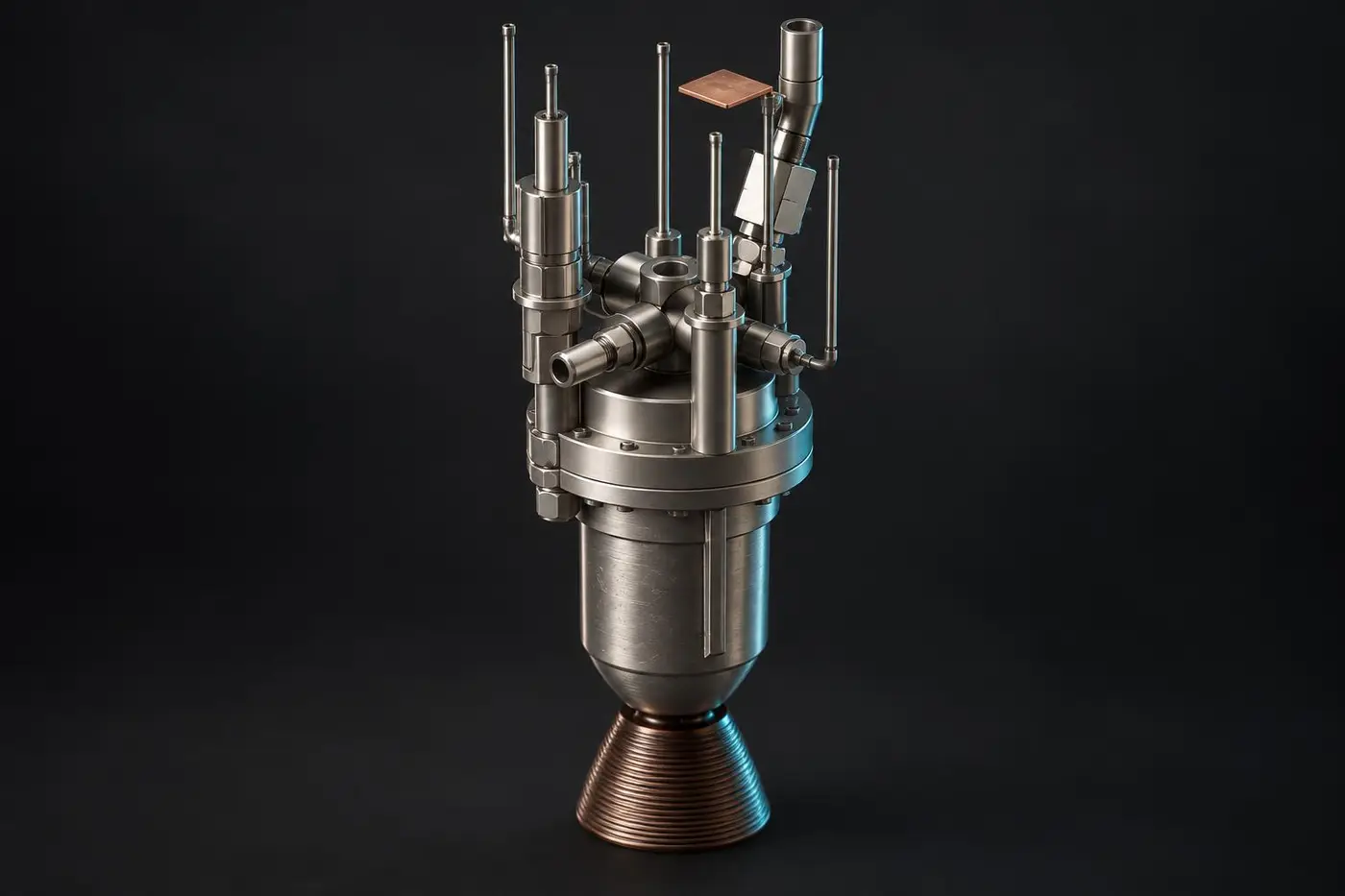
A 1.2 kN engine for orbital transfer vehicles.
OTV / PLANNED IN-ORBIT SERVICE
From release orbit to mission orbit.
Our planned EDT-powered orbital transfer vehicles wait in orbit using propellant-free propulsion. The liquid engine supports powered rendezvous and transfer manoeuvres.
- 01
Release
A rocket delivers the satellite to its release orbit.
- 02
Rendezvous
The OTV leaves its parking orbit and fires its engine to approach the satellite.
- 03
Capture
The OTV aligns with and captures the satellite.
- 04
Deliver
The connected pair transfers to the satellite’s intended orbit.
Planned mission sequence. Vehicle design, capture approach and orbital operations are in development; this is not an operational service.
01 / In-orbit satellite delivery
A rocket delivers a satellite to a release orbit, but its mission may need a different destination. We are developing orbital transfer vehicles (OTVs) to rendezvous with those satellites, capture them and deliver them to their intended orbits.
02 / Park without propellant. Manoeuvre with the engine.
Our planned EDT-powered OTVs remain parked in orbit using propellant-free propulsion. The 1.2 kN liquid oxygen and ethanol engine is being developed for powered approach and transfer manoeuvres. Propellant-free parking and liquid-engine firing have distinct roles in the service.
Illustrative hot-wall temperature
Illustrative reference curve remapped from axial position to 10 seconds. Not a time-resolved simulation, measured telemetry or confirmation of thermal safety.
03 / Propellants
Liquid oxygen with an ethanol fuel blended 75% ethanol and 25% water: a clean-burning, non-toxic fuel that is safe to handle, in an engine we designed and are building in-house.
04 / Validated in Varsha.ai
Performance, cooling and propellant flow were modelled in Varsha.ai before we cut metal.
05 / Built to scale
The combustion chamber and injector are 3D printed in copper and Inconel alloys, which removes most of the tooling and brazing steps, while standard ports let us use commercial valves and sensors. The whole engine fits inside a 150 mm diameter.
VALIDATED IN VARSHA.AI
Every programme is modelled in our proprietary physics engine before we build it.